
California Retail Market 2026 - Top 5 Thriving Retail Categories

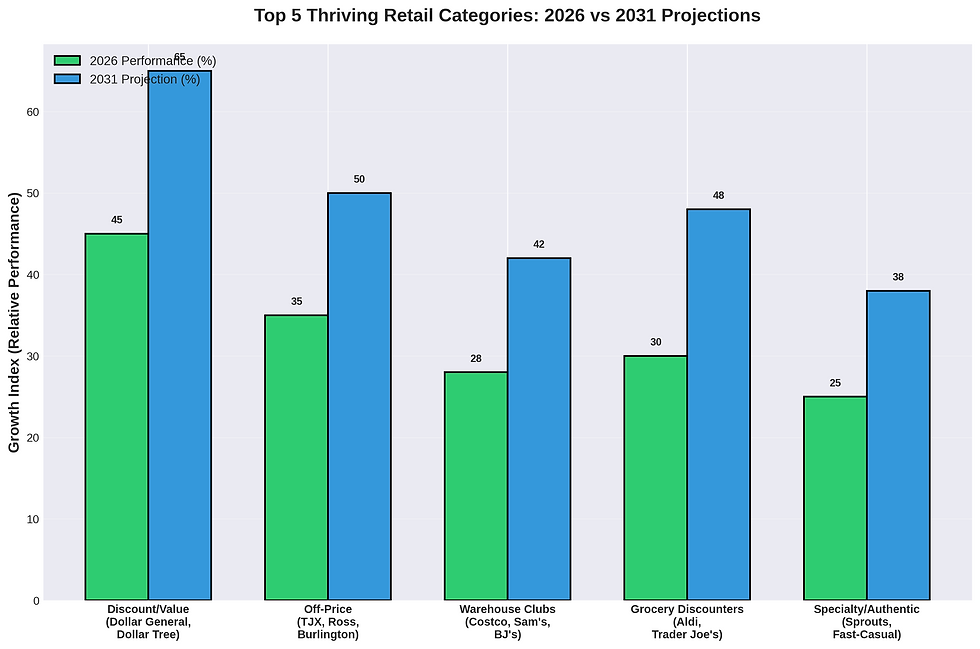
TOP 5 RETAIL CATEGORIES THRIVING IN 2026-2031
1. DISCOUNT/VALUE RETAILERS - Strongest Growth Category
Dollar General - Exceptional Performance
2026 Expansion: 450 new U.S. stores + 10 Mexico stores
2026 Plans: 4,250 store remodels, focusing on 8,500 sq ft format
Market Position: 21,000 total stores (largest dollar store chain)
Performance Metrics:
· 60% of new customers earn over $100,000 annually (no longer just low-income)
· Stock up 49.5% in 2025 (vs. 2.1% S&P 500)
· 75% of Americans live within 5 miles of a Dollar General
Dollar Tree - Strong Growth
2026 Status: Raised annual profit forecast
Performance: Stock up 25.2% in 2025
Market Position: ~16,500 U.S. locations
2. OFF-PRICE RETAILERS - "Consumer Anchor for 2026"
TJX Companies (T.J. Maxx, Marshalls, HomeGoods) - Market Leader
Q3 2025 Performance:
· EPS: $1.28 (beat estimate of $1.23, +12% YoY)
· Revenue: $15.12 billion (+7.5% YoY)
· Comparable store sales: +5% (double original 3% projection)
· Pretax margins: 12.7%
Ross Stores - Strong Performer
Q3 2025 Performance:
· Comparable store sales: +7%
· Successfully attracting Gen Z demographic
· Opened 36 Ross Dress for Less + 4 DD's Discounts in late 2025
3. WAREHOUSE CLUBS & MEMBERSHIP MODELS - Premium Value
Costco - Dominant Growth
2026 Expansion:
· 28 new warehouses in fiscal 2026
· First stand-alone gas station (Mission Viejo, CA - Spring 2026)
· 92.2% membership renewal rate (U.S./Canada)
· Trading at 52x earnings with $17 billion market cap momentum
Sam's Club - Innovation Leader
2026 Plans: 15 new locations annually
Differentiators: Scan & Go technology, superior delivery services, Member's Mark private label
4. GROCERY DISCOUNTERS - Aggressive Expansion
Aldi - Exceptional Growth Trajectory
2026 Expansion:
· 180+ new stores
· Goal: 2,800 stores by end of 2026
· Target: 3,200 stores by 2028
· $9 billion U.S. investment through 2028
Trader Joe's - Cult Following
Status: 631 locations nationwide (as of January 15, 2026)
2026 Activity: Massive Long Island distribution center (756,000 sq ft warehouse)
5. SPECIALTY GROCERS & AUTHENTIC BRANDS - Purpose-Driven Growth
Sprouts Farmers Market
Sharpened identity centered on freshness, sustainability, and health. Consistent visit growth in 2025. Attracts health-conscious consumers with differentiated positioning vs. conventional grocers.
Suburban Fast-Casual with Drive-Thrus
Key Players: Shake Shack, Chipotle, Sweetgreen - all expanding aggressively
Pivoted from urban storefronts to suburban drive-thrus, capturing remote/hybrid worker demand. Visit growth well above pre-pandemic baseline.
Market Dynamics & Store Changes

Retail Market Segmentation Shift

MARKET DYNAMICS & PROJECTIONS (2026-2031)
Consumer Behavior Shifts
1. Structural Move to Value (Not Temporary)
· 40% of Americans now deal-driven or cost-conscious
· Higher-income households reassessing "value" definition
· 70% of retail executives see this as structural change
· 25% cumulative inflation since 2020 = permanent behavior shift
2. Retail Polarization Accelerating
· Value segment: Dollar stores, off-price, warehouse clubs thriving
· Luxury segment: Modest growth, resilient high-income shoppers
· Mid-tier: Department stores, traditional retail facing extinction
· Target and Kohl's struggling to define identity
3. Authenticity & Purpose Matter
Brands with clear identity and purpose gaining visit growth. Trader Joe's, Sprouts exemplify "on-point" experience. Community-driven grocers outperforming. Generic mid-tier struggling.
Technology & Operations Trends
1. AI Investment Surge
· 87% of retailers deployed AI in at least one area
· 60% planning increased AI spending
· Predictive analytics for inventory/supply chain
· Marketing personalization (67% expect AI-driven capabilities within year)
2. Retail Media Networks
Global investment reaching $140 billion by 2026 (+12% annually). Advertising margins up to 50% (vs. low single-digit product margins). Retailers becoming advertising platforms. Critical profit driver for grocery chains.
Economic Pressures
1. Tariff Impact
Off-price retailers successfully neutralizing through opportunistic buying. Traditional retailers struggling with cost absorption. Import-dependent categories most vulnerable. Carter's cited tariffs as primary closure driver.
2. Labor & Cost Pressures
· High construction and operating costs
· Labor shortages in key markets
· California particularly challenged by high operating costs
· Automation and AI critical for cost management
Stock Performance Analysis

CALIFORNIA-SPECIFIC FACTORS
Advantages for Thriving Retailers:
· Large, affluent population supporting premium and value ends
· Diverse demographics favoring multiple retail formats
· Early adopter market for retail innovation
· Strong suburban markets (remote work boost)
· Health/sustainability consciousness supporting specialty grocers
Challenges for Struggling Retailers:
· Highest operating costs in nation (labor, real estate, utilities)
· Strict regulatory environment
· High commercial rents in prime locations
· Competitive intensity across all categories
· Consumer sophistication demands excellence
Growth Opportunities:
· Underserved rural communities (Dollar General focus)
· Suburban expansion (post-pandemic shift)
· Food deserts (discount grocer opportunity)
· Experiential retail in urban cores
· Mixed-use development integration
INVESTMENT IMPLICATIONS & RECOMMENDATIONS
Short-Term (2026)
Avoid/Reduce Exposure:
· Traditional department stores (Macy's, JCPenney)
· Mall-based specialty retail
· Retailers with high debt loads post-restructuring
· Mid-tier apparel without clear differentiation
· Physical game retailers
Increase Exposure:
· Dollar General, Dollar Tree (discount retail)
· TJX Companies, Ross Stores (off-price)
· Costco, BJ's (warehouse clubs)
· Aldi expansion (private if possible)
· Specialty grocers with clear positioning
Long-Term (2026-2031)
Structural Winners:
· Value-focused retailers across all formats
· Warehouse clubs with membership moats
· Off-price retailers with opportunistic sourcing
· Specialty grocers with authentic positioning
· Technology-enabled retail innovators
Structural Losers:
· Traditional department stores
· Mall-dependent retailers
· Mid-tier apparel without differentiation
· Retailers unable to neutralize tariff impacts
· High-overhead legacy operators
CONCLUSIONS
The California retail landscape through 2031 will be defined by:
1. Continued Bifurcation: Value and luxury thrive; middle dies
2. Operational Excellence: Only the most efficient survive
3. Purpose & Authenticity: Generic retail fails; clear identity wins
4. Technology Integration: AI and omnichannel are table stakes
5. Financial Discipline: High debt loads and inefficiency are fatal
Winners: Discount retailers, off-price chains, warehouse clubs, authentic specialty grocers, suburban fast-casual with convenience
Losers: Department stores, mall-based retail, mid-tier undifferentiated retailers, high-overhead legacy operators
The structural shift toward value-seeking behavior is permanent, not cyclical. Retailers must adapt to a consumer who is simultaneously more price-sensitive and more demanding of authentic experiences. Those who can deliver exceptional value—whether through low prices, unique products, or purpose-driven experiences—will capture outsized growth. Traditional players unable to transform will continue consolidating or disappearing.

Comments